
Diving Grand Cayman With Deep Blue Divers
Deep Blue Divers is a PADI dive centre based in George Town, the capital of Grand Cayman and the island's main harbour town. The operation is built around Master Instructor Nick Buckley, who has taught diving in Cayman waters for roughly thirty years, and around a simple idea that keeps the reviews glowing: keep the boats small, the groups personal, and the attention on the people actually breathing underwater. Across seven consecutive years the centre has earned TripAdvisor recognition, a run that says more about steady, repeatable quality than any single lucky day on the water. That combination, a long-serving instructor and a deliberately small operation, is the thread that runs through everything on this page.
Small boats change the diving in ways that are easy to feel and hard to fake. Fewer divers on board means less time waiting on a crowded swim platform, more room to gear up without elbows in your mask, and a guide who can actually watch how you move in the water rather than counting heads. It means the dive plan can flex to the group in front of them: a gentle, shallow reef when the divers are new or rusty, a longer drift along a wall when everyone is comfortable and trimmed out. A personal boat is not a marketing word here, it is the operating model, and it shapes the pace of the whole day.
George Town is a practical base for diving. It sits on the sheltered western side of Grand Cayman, the coast that stays calmest through most of the year, which shortens boat rides and smooths surface intervals. It is minutes from Owen Roberts International Airport and from the cruise harbour, so divers arriving by plane or ship do not lose half a day in transfers. The famous shore-diving sites of the west coast begin almost at the town's doorstep, and the reefs, walls, and wrecks that make the island famous are a short run offshore rather than an hour's slog.
The pages that follow are written for a wide range of readers. If you have never put your face in the water with a regulator, there is a clear, unhurried route from a first try-dive to a recognised certification. If you already carry a card and a logbook, there is detail on the walls, the wrecks, the reefs, the marine life, the seasons, and the conditions, plus honest guidance on planning a trip around diving. Where a specific operational detail would help but is not published, this guide flags it as a detail to confirm with the business rather than guessing, so you can plan on facts.
What a Small Operator Does Differently
The difference between a small dive centre and a large one is not really the destination, since everyone dives the same coast. It is the ratio of attention to divers. On a busy boat a guide has to manage a crowd, keep to a clock, and dive to the average, which nudges every trip toward the middle. On a small boat the guide can slow down for the diver who needs a moment on descent, extend a dive when the group is relaxed and breathing easy, or quietly turn one person around early without ending everyone's day.
That flexibility shows up in the small decisions that make a trip. The site can be chosen on the morning's actual conditions rather than a printed rota, the entry can be adjusted for a nervous diver, and the briefing can run as long as the group's experience calls for. Over thirty years an instructor builds a mental library of which site is best in a given wind, swell, and tide, and a small operation is designed to act on that judgement rather than override it with logistics.
Why Grand Cayman Is a World-Class Dive Destination
Grand Cayman is the largest of the three Cayman Islands, a British Overseas Territory in the western Caribbean south of Cuba and northwest of Jamaica. The islands are the exposed tops of an undersea mountain range, and that geology is the whole point for divers. The reef shelf that rings the island does not slope away gently for miles. Instead it runs out a short distance and then drops, in places almost vertically, toward the Cayman Trench, one of the deepest stretches of water anywhere in the Caribbean. That means dramatic, deep-water terrain sits astonishingly close to shore, reachable on a short boat ride rather than an expedition.
Water Clarity and Conditions
The water around Grand Cayman is famous for its clarity. Horizontal visibility frequently runs past a hundred feet and on the best days feels almost limitless, because the island has no large rivers, little agricultural runoff, and a wide belt of protected reef that keeps sediment down. Clear water is not only beautiful, it is safer and easier to learn in, since you can see your buddy, your guide, the reef, and the surface without straining. For photographers and for nervous first-timers alike, that openness takes a lot of the anxiety out of descending.
Conditions are generally friendly by Caribbean standards. The western and southern reefs are often calm, water temperatures stay comfortable year-round, and the recreational sites sit at sensible depths with clear reference points. That does not mean the sea is ever fully tame, and current, surge, and surface chop all vary by site and season, which is exactly why a small operator that can read the day and pick the right spot matters more than a fixed schedule.
A Protected Underwater Park
Cayman has a long, serious record of marine conservation. Much of the coastline falls within marine park and replenishment zones, and permanent mooring buoys are fixed at popular sites so that boats tie off instead of dropping anchors that would crush coral. Spearfishing and the taking of marine life are restricted in protected areas, and the rules are enforced. The practical result for a visiting diver is healthier reef, more fish, and dive sites that have been looked after for decades rather than loved to death.
Diving inside a well-managed marine park also sets expectations for behaviour. Guides brief on not touching, not chasing, and keeping fins clear of the coral, and good buoyancy is treated as a courtesy to the reef as much as a personal skill. This is the culture Deep Blue Divers operates within, and it is part of why the reefs here still reward divers who first visited a generation ago.
The Scale of the Drop-Off
It is worth pausing on how deep the water beside Grand Cayman gets. The Cayman Trench, the deep channel that runs south of the island, plunges thousands of metres, one of the deepest points in the entire Caribbean Sea. Divers never go anywhere near those depths, but that abyss is why the walls exist and why big animals patrol the reef edge. Sitting on a reef top at fifteen metres and looking out over a vertical drop into water kilometres deep is a genuinely humbling way to spend a morning.
This closeness of deep water to shore also keeps the diving efficient. There is no need for long steams to reach dramatic terrain, so a two-dive morning leaves plenty of the day free, and repeat visits over a week can sample walls, wrecks, and reefs without ever feeling like a commute. Few destinations pack this much variety into such a short run from the dock.
The Walls: Diving the Edge of the Deep
The wall dive is the signature Grand Cayman experience, and it is the reason many divers cross an ocean to get here. A wall dive begins over a shallow reef shelf, then follows the reef to its edge, where the seabed simply ends and drops away into deep blue. You hang in open water with the wall on one shoulder and nothing but ocean on the other, moving along a cliff face that is alive from top to bottom. It is the closest sensation to weightless flight that most people will ever have.
The walls themselves are gardens turned on their side. Barrel sponges wide enough to sit in, rope sponges, deep-water sea fans, and black coral cling to the vertical rock, and small overhangs and crevices hide lobster, cleaner shrimp, and reef fish. The North Wall in particular has a reputation among divers who have travelled widely, prized for the scale of its drop-offs and the health of its growth. On many wall sites a gentle current lets you drift and cover ground, so the guide plans the entry and exit around the water rather than fighting it.
Walls are also where the bigger animals show up. Because the deep water is right there, hawksbill and green turtles, spotted eagle rays, the occasional reef shark, and passing pelagics all cruise the edge. Keeping one eye on the wall and one on the blue is part of the craft, since the most memorable sightings often appear out of open water rather than on the reef itself.
Wall diving does ask for discipline. Good buoyancy control keeps you off the fragile growth and stops an unplanned slide into deeper water, and a dive computer plus a watchful eye on depth and gas keeps the dive well inside recreational limits. None of this is out of reach for a newer diver, who can enjoy the top of the wall and the reef shelf while more experienced divers venture a little deeper. It is one of the clearest arguments for the small-group approach, since the guide can pitch the dive to the people on the boat.
Grand Cayman's walls are not a single feature but a whole coastline of them, and they carry a character that shifts from site to site. Some drop as a clean sheer face, others step down in a series of ledges and sand chutes, and pinnacles and buttresses break the line here and there to create arches and cracks worth exploring. That variety means a week of wall diving never becomes repetitive, and a guide who knows the coast can serve up a different mood of drop-off each day.
Reading a Wall Dive
A wall dive rewards a diver who plans it in reverse. Because it is easy to keep sinking along an attractive cliff face, the discipline is to make your deepest point early, while you are freshest and your gas is fullest, then work steadily shallower as the dive goes on. That profile is not only safer, it is more interesting, since the shallower reef top holds the light, the colour, and the greatest density of small life. The blue of the deep is spectacular for a few minutes; the top of the wall is where you linger.
Buoyancy is the skill that makes or breaks a wall. With no seabed beneath you to settle on, small changes in depth have to be managed with your breath and with tiny adjustments to your buoyancy jacket, and a diver who has this dialled in floats effortlessly while the reef scrolls past. This is exactly what training and a few guided dives build, and it is why divers who have walls at home often still book a guide for their first Cayman wall, to learn the local rhythm from someone who knows it cold.
Wrecks of Grand Cayman
If walls are the island's natural wonder, wrecks are its living history lesson. A sunken ship is an artificial reef in fast-forward: within a few seasons the hull furs over with coral and sponge, baitfish move into the shelter, and the predators that hunt them follow. The structure gives fish somewhere to hide and gives divers a clear, dramatic focal point, which is why wrecks are among the most photographed sites anywhere.
Grand Cayman's most celebrated wreck is the USS Kittiwake, a former United States Navy submarine rescue vessel that was cleaned, prepared, and deliberately sunk off the Seven Mile Beach area in 2011 to serve as an artificial reef and dive attraction. She sits in relatively shallow, clear water, which makes her approachable for a wide range of certification levels, and years underwater have turned her decks and passageways into a busy reef. The Kittiwake is described here as general island context, and any operator's specific trips to it are best confirmed directly a detail to confirm with the business.
Beyond the headline wreck, Grand Cayman's waters hold a scatter of other sunken vessels of different eras and depths, from small purpose-sunk boats to older casualties broken across the reef. Some sit shallow enough for a relaxed swim-over, while others reward more experienced divers with a little depth and structure. The mix means wreck diving here is not a single tick-box site but a category you can grow into across a trip or several visits.
Diving a wreck safely is its own small discipline. Swimming over and around a hull is well within reach of newly certified divers, while actually entering a wreck, moving through enclosed spaces where you cannot swim straight up to the surface, is specialty territory that calls for dedicated training, lights, and a plan. The PADI Wreck Diver course exists precisely for this, and a good guide will keep newer divers on the outside where the light, the life, and the photography are best anyway.
Sinking a ship on purpose is a deliberate act of reef-building, not dumping. Before a vessel like the Kittiwake goes down, it is stripped of fuel, oil, wiring, and anything that could pollute or trap a diver, cleaned to strict environmental standards, and placed carefully upright on a sandy seabed away from living coral so it can become habitat rather than harm it. Done well, an artificial reef takes diving pressure off fragile natural sites while giving marine life new ground to colonise, which is why purpose-sunk wrecks have become a valued part of Caribbean diving.
Why Wrecks Teem With Life
A wreck is a magnet for marine life because it does something the flat seabed cannot: it stands up into the water and offers shelter at every scale. Tiny fish and invertebrates colonise the plating and railings, schools of silversides and grunts fill the open holds, and the predators that hunt them, from jacks to barracuda to the occasional grouper, patrol the edges. Over years the metal disappears under a crust of coral, sponge, and hydroids until the ship reads less like a machine and more like a reef with unusually straight lines.
For photographers a wreck is a gift, because it supplies the one thing open reef often lacks, a bold structure to frame the shot. A diver silhouetted in a doorway, light falling through a hatch, or a school swirling around a mast turns a snapshot into an image. It is also why wreck sites reward patience: hover, watch how the resident fish use the structure, and the picture tends to arrange itself.
Reefs, Swim-Throughs, and Shore Dives
Not every great dive is deep or dramatic. Some of the most rewarding time in Grand Cayman is spent in shallow, sunlit water over coral gardens, mini-walls, and sand channels, where the light is bright, the colours pop, and bottom times stretch out because you are nowhere near a depth limit. Shallow reef diving is where new divers build confidence, where photographers get their cleanest images, and where certified divers often choose to spend a relaxed second dive after a deeper first one.
George Town's own shoreline is home to two of the best-known shore dives in the Caribbean, Eden Rock and Devil's Grotto. These neighbouring sites are a maze of coral heads, canyons, tunnels, and cathedral-like swim-throughs in shallow, protected water, famous for the huge silver schools of tarpon that hang in the caverns and part around passing divers. They sit close to town and are a long-standing favourite for training, warm-up dives, and photography, which is one more reason a George Town base is convenient. Which specific sites feature on a given trip depends on conditions and planning a detail to confirm with the business.
Swim-throughs and grottoes add a sense of exploration without the commitment of a true overhead environment. In a proper swim-through you can generally see daylight at both ends, and the reward is beams of sunlight cutting through the blue, walls of encrusting life on either side, and the quiet thrill of threading a natural corridor in the reef. Guides pick swim-throughs suited to the group and brief them clearly, so the adventure never outruns the divers' comfort.
Shallow reefs are also the backbone of good training. Long, low-stress bottom times let an instructor drill skills without rushing, a nervous student can always see the surface, and a rusty diver can rebuild trim and buoyancy before anyone talks about walls or depth. It is the sort of diving that looks modest on paper and turns out, again and again, to be the part of the trip people talk about afterwards.
Grand Cayman's reefs change character with depth in a way that keeps repeat dives fresh. The shallowest zones are bright coral gardens full of small, busy life; a little deeper, spur-and-groove formations run coral ridges out toward the drop with sand channels between them; and beyond that the mini-walls and the main wall begin. A single site can therefore be dived several ways, staying shallow for a long, easy exploration or edging out to where the structure steepens.
Diving the Same Site Twice
One underrated pleasure of diving with a small local operator is returning to a site rather than always chasing a new name on a list. A second dive on familiar reef, with a guide who knows its ledges and residents, tends to reveal what the first swim-past missed: the moray under a particular overhang, the cleaning station the turtles visit, the crack where a lobster waves its antennae. The site does not change, but your eye does, and a guide who dives it weekly can steer you to the good corners.
This is also why a printed dive-site checklist is a poor measure of a trip. Counting names logged says little about the quality of the diving, while two relaxed dives on a well-known reef, unhurried and shared with a knowledgeable guide, often deliver more genuine wildlife time than a rushed tour of headline spots. The small-boat model leans naturally toward this slower, richer way of diving.
Marine Life You Will Meet Underwater
Sea turtles are close to a sure thing on Grand Cayman reefs. Green and hawksbill turtles graze the coral and rest under ledges, often unbothered by respectful divers who keep their distance, and a turtle drifting overhead against the light is one of the classic Cayman images. Southern stingrays glide across the sand flats, and spotted eagle rays, with their long tails and freckled wings, cruise the reef edges and the walls, sometimes in small groups.
Sharks are part of the ecosystem and, for most visitors, a highlight rather than a worry. Caribbean reef sharks and docile nurse sharks are the ones divers are most likely to encounter, usually keeping their distance and moving on. The reality of reef diving here is that sharks are wary of divers, encounters are brief, and they are a sign of a healthy reef doing what it should. A calm, informed briefing turns the idea of sharks from a nerve into one of the best things you can hope to see.
The reef fish are a constant, colourful backdrop. Nassau grouper, curious and sometimes surprisingly bold, share the reef with rainbow parrotfish crunching coral, queen and French angelfish, sergeant majors, snapper, and the ever-present barracuda hanging motionless in the current. Green moray eels peer from crevices, and the tarpon of the George Town caverns move like slow silver mirrors. Each site has its regulars, and part of the pleasure of diving with the same small operator is a guide who knows which animals live where.
For divers who like to look closely, the small stuff is just as rich. Garden eels sway from the sand in colonies, seahorses cling to gorgonians for those who know where to look, secretive octopus change colour and texture in a blink, spiny lobster back into ledges, and cleaner shrimp set up stations that larger fish queue to visit. Seasonal visitors pass through too, and conditions and time of year shape what turns up, which is part of why no two dives here feel quite the same.
Sea turtles carry an extra weight of meaning in Cayman, whose very name traces back to the region's turtles and whose history is tied to them. Today the animals a diver meets on the reef are wild and protected, and encountering a green or hawksbill turtle calmly grazing coral is a reminder of how far conservation has come. Keeping a respectful distance and letting the turtle set the terms of the meeting is both good manners and the reason these encounters remain so easy to come by.
Part of the joy of clear, healthy reef is watching behaviour rather than just ticking off species. Cleaning stations, where small wrasse and shrimp pick parasites from much larger fish that hover patiently to be serviced, are a window into the reef's quiet cooperation. Parrotfish audibly crunch coral and help make the island's white sand, damselfish fiercely defend a patch of algae many times their size, and a hunting trumpetfish will shadow a larger fish to sneak up on prey. Hover still, watch, and the reef stops being scenery and starts being a story.
Seasonal Visitors and Special Encounters
Alongside the reef residents present all year, Grand Cayman's waters see seasonal comings and goings that reward divers who ask what is around during their visit. Certain months bring better chances of particular encounters as water temperatures and currents shift, and long-serving local guides track these patterns closely because they dive the same sites week after week. It is always worth asking what has been showing up lately, since a guide who is in the water daily knows far more than any printed calendar.
Respect is the price of the best encounters. The animals that let divers close are the ones that have learned humans are neither predator nor food, and that trust survives only if visitors keep their distance, avoid cornering or chasing, and never feed wildlife to force a sighting. A patient, quiet diver who lets the reef come to them almost always sees more than one who rushes at every shadow, and the sightings feel earned rather than staged.
Learning to Dive: The PADI Pathway
PADI, the Professional Association of Diving Instructors, runs the most widely recognised training system in the world, and a PADI card earned in Grand Cayman is honoured at dive centres everywhere. As a PADI centre led by a Master Instructor, Deep Blue Divers can take someone from a first, tentative breath underwater all the way to professional-level training, in clear, step-by-step stages. The pathway below describes the standard PADI courses in general terms so you know what each stage involves before you ever pick up the phone.
Discover Scuba Diving
Discover Scuba Diving is the try-before-you-commit option, and it is not a certification. Under the direct supervision of a professional, a complete beginner learns a few essential concepts and skills in shallow, controlled conditions, then makes a real dive to see what breathing underwater is actually like. It is the ideal first step for anyone curious but unsure, for cruise visitors with a single day, or for a hesitant partner testing the water before signing up for a full course. Minimum age and exact depth limits follow standard PADI rules, and specifics for a given day are worth confirming a detail to confirm with the business.
PADI Open Water Diver
The PADI Open Water Diver course is the entry-level certification and the licence to dive independently with a buddy, generally to eighteen metres or sixty feet. It has three parts: knowledge development covering the theory of pressure, gas, equipment, and dive planning; confined-water sessions where you practise core skills in calm, shallow conditions; and four open-water training dives in the sea. Many people spread it across three to four days, and in a place like Grand Cayman those open-water dives are made on genuinely beautiful reef rather than a murky quarry.
Two features make the course flexible for travellers. PADI eLearning lets you complete the theory online before you fly, so your holiday time goes to the water instead of a classroom. And the referral system lets you finish the classroom and confined-water portions with a PADI instructor at home, then complete only the open-water dives in Cayman, arriving ready to dive. Either route is worth raising when you enquire so the schedule can be built around it a detail to confirm with the business.
Advanced, Rescue, and Beyond
Once certified, the pathway keeps opening up. The Advanced Open Water Diver course is built around five adventure dives, including deep and underwater navigation, and it extends your depth limit toward thirty metres or a hundred feet, which unlocks more of Cayman's walls and wrecks. Rescue Diver, widely described as the most rewarding course in the system, teaches you to prevent and manage problems and to help other divers, and it is the gateway to professional training as a Divemaster. Specialties such as Enriched Air Nitrox, Deep, Wreck, and Underwater Photography let you tailor your diving to what you actually love. Which specialties run and when depends on the centre's schedule a detail to confirm with the business.
Refreshers for Rusty Divers
Certification does not expire, but skills fade. If it has been a while since your last dive, a refresher such as PADI ReActivate or a scuba review rebuilds your comfort with equipment, buoyancy, and safety drills in shallow water before you head out to the reef. It is a small investment that makes the first dive of a trip relaxed instead of tense, and a small operator can fold it neatly into the start of your diving so you are not the person on the boat trying to remember how a buoyancy jacket works.
Specialty Courses Worth Considering
Beyond the core certifications, PADI specialty courses let you dive deeper into the parts of the sport that excite you, and several suit Cayman especially well. Enriched Air Nitrox, a higher-oxygen breathing mix, can extend your no-decompression time on repetitive dives, a real benefit when you are diving two or three times a day for a week. The Deep and Wreck specialties open up more of the island's terrain safely, while a Peak Performance Buoyancy course pays for itself on every dive by making you calmer, more efficient, and kinder to the reef.
Underwater photography and videography specialties are another natural fit for water this clear. Learning how light behaves at depth, how to get close, and how to hold steady turns the frustration of blue, blurry snapshots into images worth keeping. Which specialties Deep Blue Divers runs, and when, depends on the centre's schedule and demand, so it is a good question to raise when you plan a longer diving trip a detail to confirm with the business.
Continuing as a Dive Professional
For divers who fall hard for the sport, the PADI pathway keeps going past recreational levels into professional training. Divemaster is the first professional rating, where a diver learns to guide, assist instruction, and take real responsibility for others in the water, and it is the natural next step after Rescue Diver. Training under an experienced Master Instructor, on reefs dived thousands of times, is a strong foundation for anyone considering a career in diving or simply wanting the deepest possible mastery of their hobby. Availability and prerequisites for professional courses are best discussed directly a detail to confirm with the business.
What a Day of Diving Looks Like
A diving day usually starts with the unglamorous but important part: paperwork and gear. You confirm your certification level and recent experience, complete a medical questionnaire, and, if you are renting, get sized for a wetsuit, mask, fins, and a buoyancy jacket. With a small operation this stage is quick and personal, and it is the moment to mention anything relevant, a long time since your last dive, an ear that clears slowly, a camera you want to bring, so the guide can plan for it.
Then comes the boat. Grand Cayman's popular sites are close in, so the ride out is short, and on a small, personal boat there is space to gear up calmly rather than jostling for a bench. Before anyone gets wet the guide runs a site briefing: the layout of the reef or wall, the planned maximum depth and time, the entry and exit, the expected current, hand signals, and the marine life to watch for. A good briefing is where an experienced local guide earns their keep, because they are describing water they have dived hundreds of times.
The dive itself follows a familiar rhythm. You make a controlled descent along the reef or a mooring line, settle into neutral buoyancy, and follow the guide's plan while keeping an eye on your air, depth, and no-decompression limit on your computer. On a wall you drift the edge; on a reef you weave the coral heads; on a wreck you circle the structure. Near the end you ascend slowly and pause for a safety stop, typically three minutes at around five metres, before surfacing where the boat can see you.
Most trips are built as a two-tank outing, two dives with a surface interval between them, though exact formats vary. During the interval you swap to a fresh tank, warm up, drink water, and let your body release nitrogen before the next dive, which is planned to be shallower than the first. It is an easy, sociable pause, and on a small boat it tends to be the moment the group compares notes on what they saw. Precise schedules, single-tank options, and afternoon or shore-dive trips are worth confirming a detail to confirm with the business.
A few habits make a diving day more comfortable. Arrive well rested and properly hydrated, since dehydration is a genuine risk factor for decompression problems, and go easy on alcohol the night before. Eat a light, settling meal rather than diving on an empty or overloaded stomach, and if you are prone to motion sickness, sort out a remedy in advance and take it early, because feeling queasy on a small boat is far easier to prevent than to cure once the swell picks up.
After the Dive
The dive is not quite over when you climb back up the ladder. Good practice is to rinse and stow your gear, drink water, and take a proper surface interval before any further diving, all of which a small crew makes easy and unhurried. It is also the moment to log the dive while it is fresh, noting the site, depth, time, conditions, and what you saw, which builds the record future operators and courses will want to see and, more importantly, sharpens your own sense of how you dive.
Between dives and at the end of the day, the small-boat setting tends to turn strangers into a group. People compare the turtle they saw, the eel they missed, and the photo that nearly worked, and a guide who has dived the site for years fills in the gaps and points to what to look for next time. It is a relaxed, social close to a morning on the water, and it is part of why divers come back to the same small operations trip after trip.
Gear, Safety, and Diving Responsibly
The core kit for warm-water diving is straightforward: a mask and fins, a wetsuit suited to the season, a buoyancy control device, a regulator with a submersible pressure gauge, and a dive computer. Cayman's water is warm enough that many divers are comfortable in a thin wetsuit or even a rash guard in high summer, while a slightly thicker suit is welcome on repetitive dives or in the cooler months. If you own gear you trust, especially a mask that fits and your own computer, bring it; rental availability and pricing are best confirmed directly a detail to confirm with the business.
Safety in recreational diving is a system, not a slogan. It runs on thorough briefings, the pre-dive buddy check, conservative dive planning inside no-decompression limits, a dive computer on every wrist, and a proper safety stop before surfacing. Boats carry emergency oxygen and first aid, and crews are trained to respond. Grand Cayman also has an important reassurance close at hand: the island is served by a hyperbaric recompression chamber in George Town, so treatment for a dive injury does not require a long evacuation. Divers Alert Network membership, which covers dive-specific medical costs and evacuation, is sensible for any travelling diver.
Health honesty is part of safety. Every diver completes a medical questionnaire, and certain conditions, from recent surgery to some heart, lung, or ear problems, may call for a doctor's sign-off before diving. This is not bureaucracy, it is the mechanism that keeps a treatable issue on land from becoming an emergency at depth. If anything on the form applies to you, sort out the paperwork before your trip so a great diving day is not lost to a last-minute clearance.
Diving responsibly is the final piece, and in a marine park it is non-negotiable. That means excellent buoyancy so your fins never touch the coral, keeping hands to yourself, never chasing or feeding wildlife, taking only photographs, and choosing reef-safe sunscreen so what washes off your skin does not harm the reef you came to see. These habits are why Cayman's dive sites remain worth the trip decade after decade, and a conscientious operator reinforces them on every briefing.
The Two Pieces Worth Owning
If you dive occasionally and rent most of your kit, two items still repay owning outright: a well-fitting mask and a dive computer. A mask that seals to your face without leaking removes the single most common irritation of a dive, and because fit is personal, a rented mask is always a compromise. Buy one, learn to defog it, and take it everywhere. It is small, light, and it makes every dive smoother.
A personal dive computer is the other. It tracks your depth, time, and no-decompression status continuously, adapts to your actual profile rather than a printed table, and remembers your recent dives so repetitive diving over a week stays conservative and safe. Learning your own computer, its display, its alarms, and its logbook, means you are never squinting at an unfamiliar rental in the middle of a dive. Rental computers are widely available if you prefer, which is worth confirming when you book a detail to confirm with the business.
Ears, Sinuses, and Equalising
The most common reason a dive goes wrong for a beginner has nothing to do with sharks or depth: it is the ears. As you descend, water pressure squeezes the air spaces in your ears and sinuses, and you have to equalise that pressure gently and often, usually by pinching your nose and blowing softly, from the very first metre. The golden rule is to equalise early and repeatedly and never to force it or push through pain. If your ears will not clear, you stop, ascend slightly, and try again.
Congestion is the enemy of easy equalising, so diving with a heavy cold or blocked sinuses is a bad idea, since it can trap air and cause a painful squeeze or a reverse block on the way up. Descend slowly, stay relaxed, and tell your guide if an ear is being stubborn, because a good instructor will happily take an extra minute on the line rather than rush you down. Most equalising trouble is solved by patience, and it is a skill that becomes second nature within a few dives.
Who Grand Cayman Diving Suits
One quiet strength of Grand Cayman as a dive destination, and of a small operator working it, is how wide a range of people it fits. The same coastline that thrills a seasoned wall diver also gives an anxious first-timer a gentle, shallow, sunlit introduction, and a small boat is far better placed than a big one to serve both on the same morning without shortchanging either.
Complete Beginners and Nervous First-Timers
If you have never dived, or if the idea makes you anxious, this is close to an ideal place to start. Warm, clear, calm water removes much of what makes learning stressful elsewhere, and a Discover Scuba session lets you try the sensation under a professional's direct eye before committing to a course. Nerves on a first descent are normal, and the fix is almost always a patient instructor, a shallow site, and permission to go at your own pace, all of which a small operation is set up to provide.
Families and Younger Divers
Grand Cayman works well for families who want to share the water. Pool-based programmes introduce children to breathing underwater in safe, shallow conditions, junior certifications let older children dive within sensible depth limits, and non-diving family members have beaches, snorkelling, and boat trips close by. Coordinating ages, programmes, and timings is exactly the sort of thing to arrange in advance with the operator so a family trip runs smoothly a detail to confirm with the business.
Returning Divers and the Rusty
Plenty of people certify, dive on a holiday or two, and then let years pass. If that is you, you are neither alone nor stuck: a short refresher rebuilds the muscle memory for mask clearing, buoyancy, and safety drills in shallow water, and then the reef is yours again. A small operator can fold a refresher into the start of your trip so the first proper dive feels like a return rather than a nervous restart, which sets the tone for the rest of the week.
Experienced Divers and Photographers
For confident, experienced divers, Grand Cayman is a playground of walls, wrecks, swim-throughs, and clear water, and a small-group boat means less waiting and more of the diving you actually came for. Underwater photographers are especially well served, because the visibility, the light, and the varied structure give you something to shoot on every dive, and a guide who knows where the subjects live can put you in the right place. Tell the operator what you are chasing, and the diving can be tuned to it.
Seasons, Visibility, and the Best Time to Dive
Grand Cayman is a year-round diving destination, and there is no month that shuts the water down. Sea temperatures are warm throughout the year, easing from the high twenties Celsius, around the low eighties Fahrenheit, in the peak of summer to the mid-twenties Celsius, roughly the high seventies Fahrenheit, in the coolest winter weeks. That comfort band is one reason so many divers return in different seasons, since even the coolest water here is warmer than many home coastlines in high summer.
Summer, roughly late spring through early autumn, tends to bring the calmest seas, the warmest water, and the longest stretches of glassy visibility. It also overlaps the Atlantic hurricane season, which runs from June into November. In practice serious storms are occasional and well forecast, Cayman is highly prepared, and most trips are unaffected, but it is sensible to watch the forecast and to consider travel insurance for peace of mind if you book in that window.
Winter diving is excellent, with one local quirk worth knowing. Cold fronts sweeping down from the north, known locally as Nor'westers, can churn up the usually calm western coast for a day or two at a time. The classic answer is simply to move: with three sides of the island to choose from, crews follow the lee and dive the sheltered coast, which is one more place a nimble, small operator has the edge over a big, fixed schedule. Marine life, clarity, and reef health remain outstanding all winter.
The best time to dive, then, is mostly about your own priorities. Chase the flattest seas and warmest water and you lean toward summer; prefer cooler air, fewer crowds, and a good chance of migrating visitors and you lean toward winter. Either way, the smart move is flexibility: give the operator a couple of possible days rather than a single fixed slot, and let them pick the window and the site that the conditions actually favour.
Planning Around the Weather
The practical takeaway on seasons is to build in flexibility rather than lock yourself to a single plan. Wind and swell can nudge conditions from one part of the coast to another within a day, so a trip that keeps a couple of possible diving windows open will almost always find good water somewhere around the island. This is the everyday advantage of a small, mobile operator: instead of cancelling when one coast is rough, the sensible move is often simply to dive a sheltered side.
For divers travelling in the June-to-November storm season, a little planning removes most of the worry. Watch the forecast in the days before you fly, book diving early in your stay so a passing system does not eat your only chance, and carry travel insurance that covers weather disruption. Serious storms are the exception rather than the rule, and Cayman's infrastructure is built to handle them, but a flexible itinerary turns a possible frustration into a non-issue.
Getting There and Planning Your Visit
Getting to the diving is easy. Owen Roberts International Airport sits on the edge of George Town, and Grand Cayman is well connected by direct flights from several United States gateways, from the United Kingdom, and from Canada, with regional links across the Caribbean. Because the airport and the dive centre are both in the George Town area, the transfer from touchdown to town is short, and it is realistic to arrive and settle in with time to spare before your first day underwater.
George Town is also Grand Cayman's cruise port, and diving is a popular shore excursion for passengers. If you are visiting by ship, plan carefully around your sailing time and around dive-and-fly-or-sail intervals, and build in a comfortable margin so a surface interval or a delayed boat never risks the gangway. Confirming timing and pickup arrangements ahead of the day is essential for cruise visitors a detail to confirm with the business.
Practical details are simple once you know them. The local currency is the Cayman Islands dollar, which is pegged to the United States dollar, and US dollars are widely accepted, though you may receive change in local currency. Traffic drives on the left, taxis and car hire are readily available, and the island runs on Eastern Standard Time with no seasonal clock change. Accommodation ranges from Seven Mile Beach resorts to George Town hotels and self-catering condos, most within an easy reach of the dive centre.
One rule sits above all the logistics: do not fly too soon after diving. Guidance from the diving medical community suggests waiting at least eighteen hours after a single dive, and longer after repetitive or multi-day diving, before boarding a flight, because cabin altitude can trigger decompression problems that would not occur at sea level. The clean way to plan a trip is to dive early and often and to keep your last dive at least a full day clear of your flight home, so you never have to cut a dive or a departure short.
Travel insurance deserves a specific mention for divers. Standard holiday policies often exclude scuba diving or cap it at shallow depths, so check the wording and, if needed, add proper diving cover or take out a dedicated diver policy. Pairing that with Divers Alert Network membership, which is built around dive medicine and evacuation, means an unlikely problem underwater does not become a financial one on top of a medical one.
If you bring your own equipment, a little packing sense saves grief. Carry irreplaceable and fragile items such as your mask, dive computer, and regulator in your hand luggage rather than trusting them to the hold, spread heavy gear to stay within airline weight limits, and make sure anything with a battery meets the airline's rules. Rinse and dry kit before the flight home so it does not travel damp, and leave a little space for the reef-safe sunscreen and rash guard you will want on the boat.
Where to Stay for Diving
Grand Cayman offers accommodation to suit most budgets, and for a diving trip the west coast around George Town and Seven Mile Beach is the convenient choice, keeping you close to the dive centre, the airport, restaurants, and the calm lee coast. Options run from full-service beach resorts to smaller hotels, guesthouses, and self-catering condos, the last of which suit divers who like an early start and a simple breakfast before a morning boat.
Staying further out, on the quieter north or east of the island, trades a little convenience for peace and space, and can be lovely for a mixed holiday. If you base yourself away from George Town, factor in the drive to the dive centre and confirm timings so you are never rushing to make a boat. Whichever you choose, booking accommodation and diving to line up sensibly is worth a few minutes of planning a detail to confirm with the business.
Beyond the Dive: George Town and Grand Cayman
A dive trip rarely travels alone, and Grand Cayman gives non-diving companions plenty to do while you are underwater. Seven Mile Beach, one of the most celebrated stretches of sand in the Caribbean, runs up the west coast with calm, clear water ideal for swimming and snorkelling. Stingray City, the shallow sandbar in the North Sound where southern stingrays gather, is a bucket-list boat trip that snorkellers and non-divers can enjoy alongside certified divers, and it makes an easy shared day on the water.
George Town itself is worth the time between dives. The waterfront has duty-free shops, casual and upscale restaurants, and the small museums that tell the island's seafaring story, and it is compact enough to explore on foot. A short drive north, Camana Bay is a modern waterfront town with dining, shopping, an observation tower, and events, a pleasant contrast to a morning on the reef and a good place to reconvene with anyone who stayed on land.
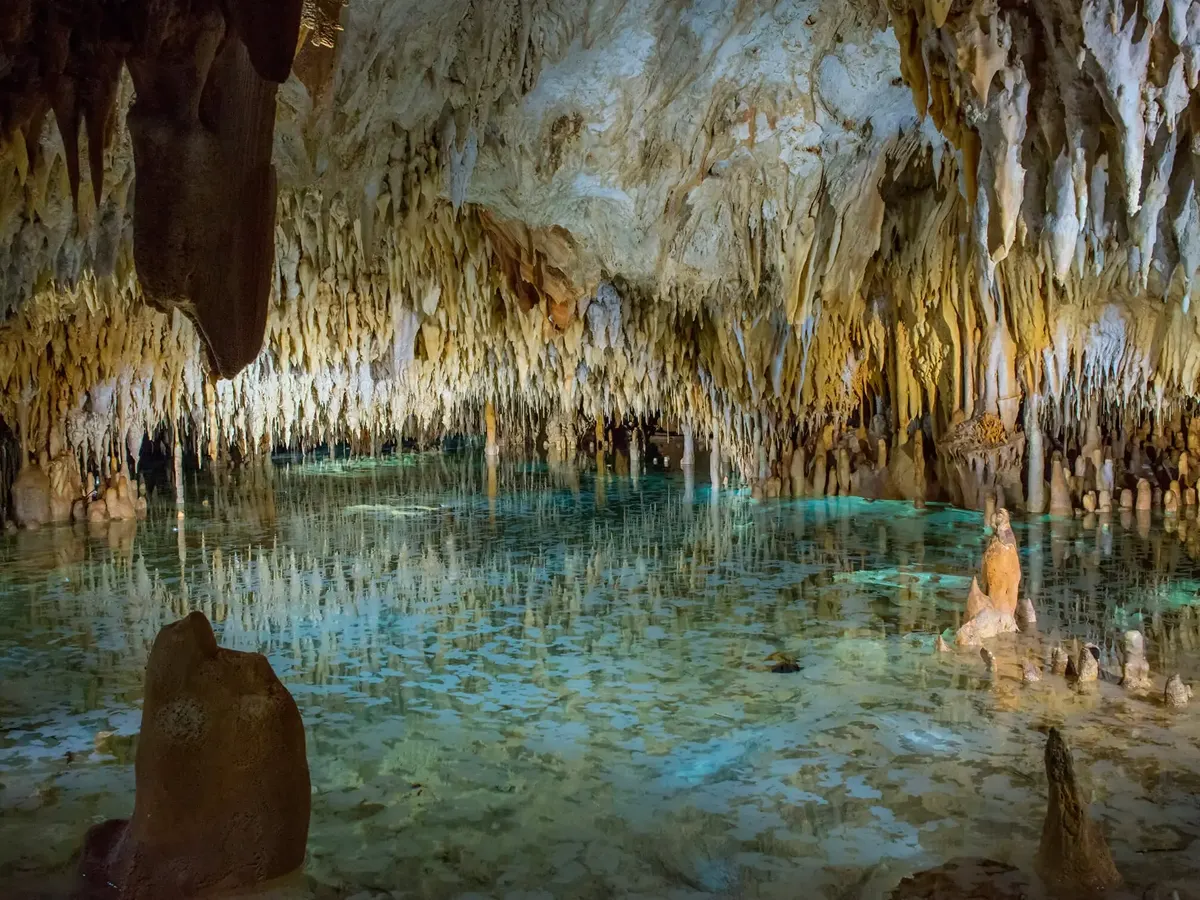
The rest of the island rewards a rental car and a free afternoon. Rum Point and Starfish Point on the quieter north side offer soft sand and shallow, warm water; the Crystal Caves inland open a world of stalactites and underground pools; the Queen Elizabeth II Botanic Park protects native wildlife including the blue iguana; and on a dark night the bioluminescent bay glows when the water is disturbed. None of it competes with the diving, all of it rounds out a holiday.
Put together, a Deep Blue Divers trip slots neatly into a broader Grand Cayman holiday. Dive in the calm of the morning when the sea and the light are at their best, then spend the afternoon on the beach, in town, or exploring the island, and keep the diving to the early part of the trip so your last day is free and your flight home is safely clear of your last dive.
Building Rest Days Into a Dive Trip
A good dive holiday is not only about maximising dives. Spacing the diving with a rest day or two lets your body offload nitrogen, gives sunburn and tired ears a chance to recover, and keeps the whole trip enjoyable rather than a grind. Cayman makes those rest days easy to fill, with beaches, town, and inland attractions all close by, so a non-diving day never feels like wasted time.
Rest days also protect the end of your trip. Because you should keep your final dive well clear of your flight home, a natural pattern is to dive hard in the first part of the holiday and wind down with land-based days at the end. That way your last full day is spent on a beach or exploring the island rather than watching the clock, and you board your flight with the fly-after-diving interval comfortably behind you.
Booking Your Dive With Deep Blue Divers
Booking is refreshingly direct. Deep Blue Divers can be reached by phone and by WhatsApp on +1 345 916 1293, and online at deepbluediverscayman.com. WhatsApp in particular is a practical way for international visitors to sort out details before they arrive without worrying about call charges, and it leaves you a written thread of the plan you agreed. Reaching out ahead of your dates, rather than hoping to walk up on the day, gives the best chance of the slot and the course you want.
Have a few things ready when you get in touch. Know your certification level and agency, roughly when you last dived, the dates you are on the island, how many are in your group, and whether anyone is a complete beginner, a nervous returner, or chasing something specific like a wall or a wreck. If you are certified, bring your certification card and logbook to the island, and if you take any diving course, remember your final open-water dives must be kept clear of your flight home.
A short list of things is best confirmed with the business directly, because they are operational and can change: current prices and course fees, exact daily schedules and meeting points, the boat's capacity and typical group size, gear rental and sizing, options such as Nitrox or night dives, whether non-diving snorkellers can join a trip, and the deposit and cancellation policy. Ask these when you enquire, and they are all marked in this guide as a detail to confirm with the business so nothing here is presented as fixed when only the operator can say.
The pitch is simple, and it is the same one the reviews keep making: an island with some of the finest, clearest, most varied diving in the Caribbean, and a small, personal operation run by an instructor who has known these reefs for thirty years. New divers drawing a first breath and seasoned divers logging another wall get the same careful attention, and that is a combination worth booking. The first step is a message or a call.
Questions Worth Asking When You Book
A short, focused enquiry gets you the best answer. Say clearly what you want, a certification course, guided fun dives, or a first try-dive, and give your certification level, roughly when you last dived, your dates, and your group size and ages. Flag anything that affects planning, such as a nervous diver, a medical form question, a camera you want to bring, or a cruise-ship timetable, so the operator can tell you honestly what fits.
Then confirm the operational details that only the business can settle: current prices and course fees, exact schedules and where to meet, boat and group size, gear rental and sizing, options such as Nitrox or night dives, whether a non-diving companion can come along, and the deposit and cancellation policy. Every one of these is marked in this guide as a detail to confirm with the business, because they are the operator's to set and they can change with the season.