
A 251 foot US Navy submarine rescue ship stands on the sand off Seven Mile Beach, shallow enough for snorkellers to read her story and rich enough for divers to spend days in it.
The Kittiwake was launched in 1945 as a Chanticleer class submarine rescue vessel and spent nearly five decades tending the US Navy submarine fleet: standing by on sea trials, training rescue divers, recovering torpedoes and hardware from the seabed. Her crews logged thousands of chamber hours, and her most famous assignment came in 1986, when her divers helped recover wreckage from the space shuttle Challenger off Florida. Ships with resumes like hers usually end as razor blades. This one got a better retirement.
After years of preparation, cleaning, cutting wide access holes, stripping hazards, the Cayman Islands sank her upright on sand off the north end of Seven Mile Beach in January 2011, creating the friendliest serious wreck in the Caribbean. She settled in about 65 feet of water with her superstructure reaching to within 15 feet of the surface. A storm in 2017 leaned her gently onto her port side, which locals will tell you only improved the photographs: the companionways now run at cinematic angles and the light falls through her in sheets.
Five decks are open and honestly navigable, with the kind of wide, bright swim-throughs that make wreck diving feel like architecture rather than caving. The recompression chamber is still in place, its wheel a mandatory photograph. The mess deck, the heads with their improbable mirrors, the wheelhouse where every diver briefly takes command: all of it is accessible to any comfortable open water diver with a guide, and the exterior alone rewards those who prefer to stay outside. Depth does the rest of the favours: at 65 feet maximum, bottom time is generous and the light never really leaves.
Fifteen years of ocean have upholstered the hull in sponge, cup coral and algae gardens. Barracuda hold station over the bridge like retained officers, horse-eye jacks orbit the mast, garden eels carpet the surrounding sand, and eagle rays glide the perimeter on patrol. Turtles pass through, groupers loiter in the shade of the hull, and on lucky days the silversides move in and turn her passageways to liquid metal.
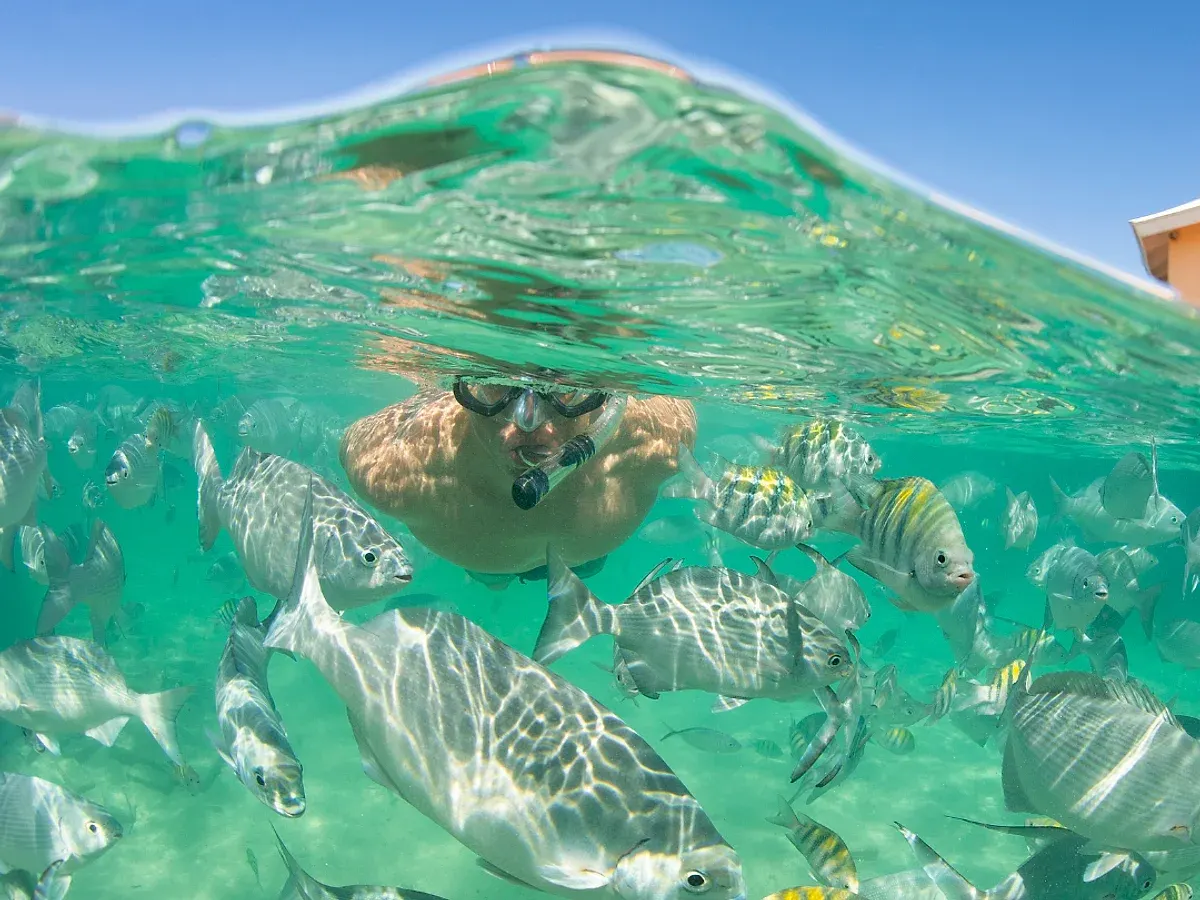
Because her upper works sit within 15 feet of the surface, the Kittiwake is that rarity: a genuine wreck experience for snorkellers. On a calm morning the whole ship is legible from above, funnel to stern, with divers' bubbles rising past you like champagne. Snorkel trips run from Seven Mile Beach and George Town; conditions matter more for the surface view, so let the operator pick the day.
The wreck sits inside a marine park with fixed moorings, visited through licensed operators; a small park fee is normally folded into the trip price. Divers should book a two tank trip pairing her with the adjacent reef wall. Photographers want the first boat of the morning for still water and empty decks. ★ Deep Blue Divers runs her regularly and briefs her properly.
The Kittiwake is the most forgiving wreck photography classroom in the Caribbean: shallow enough for natural light, white sand below her acting as a giant reflector, and structure on every axis. Wide angle owns the exterior, especially the bow from below and the props at the stern; inside, the mess deck portholes and the recompression chamber wheel are the signature frames. Morning boats get still water and empty decks; the 2017 lean means level horizons now take deliberate care, which is half the fun.
Trips depart from Seven Mile Beach and George Town daily in season, diving her as a single tank, or as the first of two tanks with the adjacent reef wall as the second. Snorkel visits run on calm mornings. The marine park fee is small and normally included; touching, entering restricted spaces or removing anything is prohibited and enforced. Book a day ahead in high season, two for the first boat.
Yes. Her upper structure sits within about 15 feet of the surface, so snorkellers get a full view of the wreck on calm days. Trips run from Seven Mile Beach and George Town.
She rests in about 65 feet of water with the superstructure reaching to 15 feet. The modest depth means generous bottom time and bright light throughout.
Yes. Wide access holes, an upright-to-gently-leaning profile and 65 foot maximum depth make her suitable for any comfortable open water diver with a guide.
A 1945 Chanticleer class submarine rescue vessel, she served the US Navy for nearly five decades and helped recover wreckage from the space shuttle Challenger in 1986 before being sunk as a Cayman reef in January 2011.
Visits go through licensed operators and a small marine park fee applies, usually included in the trip price.
Ready-made George Town shore plans with honest timings, everything walkable from the tender.