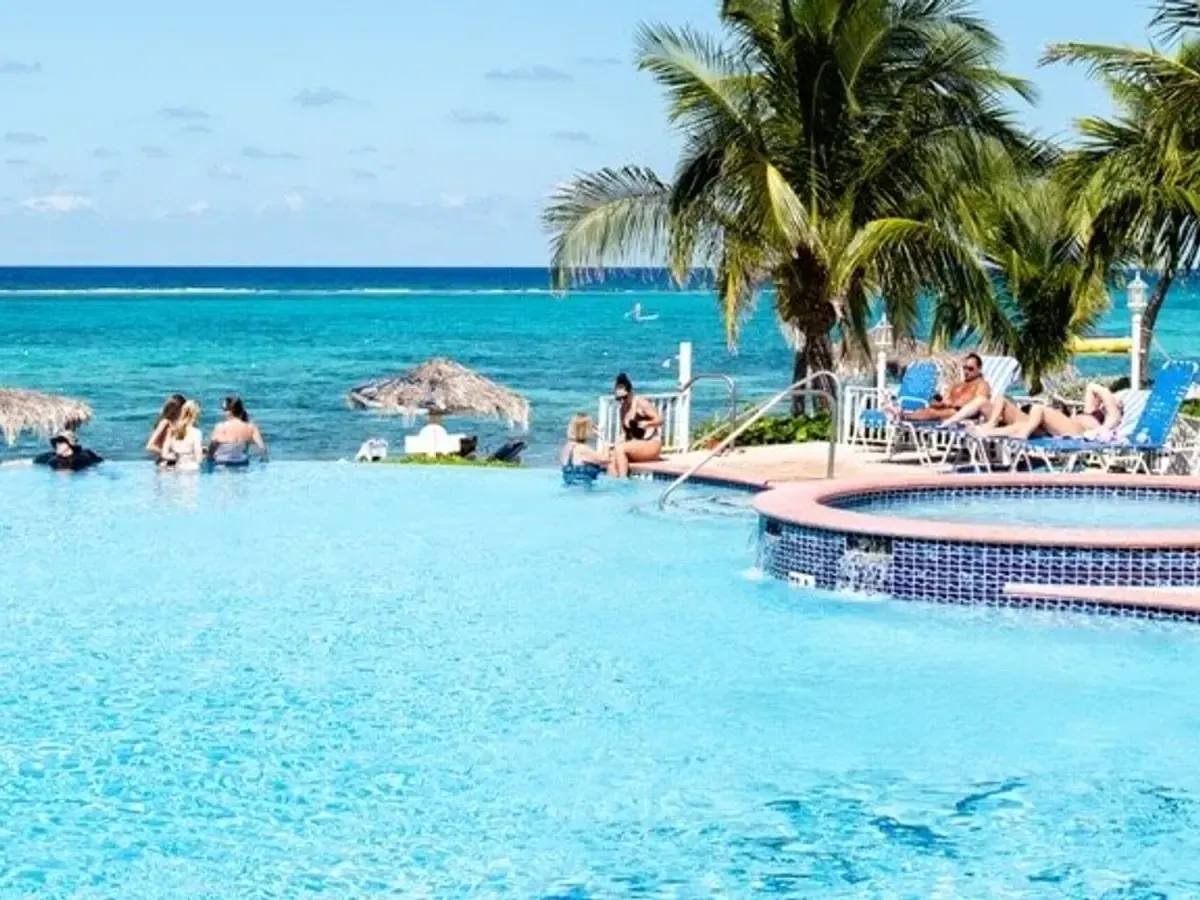
An oceanfront address on Grand Cayman's East End
The Genevieve at Morritt's is a collection of fifteen oceanfront residences on the East End of Grand Cayman, the island's quiet windward coast. It is the newest chapter in the Morritt's story, a low-rise building placed close to the water with the reef breaking just offshore and a rooftop pool set at the very top. Where much of Grand Cayman's development gathers along Seven Mile Beach and around George Town, The Genevieve looks the other way, east, toward open sea and the slow rhythm of a coast that has kept its calm.
The whole collection runs to just fifteen homes, which is the first thing worth understanding about it. There are two three-bedroom penthouses, The Genevieve and The Horizon, and twelve two-bedroom residences across three layouts named The Coral, The Shore and The Reef. That deliberate scarcity shapes the entire feel of the place. You are not buying into a tower of hundreds of units with lift queues and anonymous corridors. You are joining a small, named group of owners who share one rooftop, one shoreline and one address.
What sets The Genevieve apart from a hotel booking is the ownership model behind it. These residences are offered as deeded weekly vacation ownership rather than as nightly rooms. You hold a real, recorded interest in a specific week each year, the same week, every year, for life, and you can pass it on to family or place it in the rental programme when you are away. It is a way to own a piece of the Caribbean without carrying a whole second home twelve months of the year.
The building is completing in the fourth quarter of 2026, and private preview tours are booking now. That timing matters for buyers who want first choice of orientation, floor and layout while the collection is still taking shape, because with only fifteen homes the best positions go early. A preview is also the honest way to judge a residence like this, standing on a terrace with the trade wind on your face and the reef in front of you, rather than reading a floor plan on a screen.
For everything in this guide that touches a specific figure not yet published, such as pricing, maintenance costs or the exact terms of a given week, treat it as something to confirm directly. The residences, the layouts, the square footage, the rooftop pool and the shared resort amenities described here are all part of the offering. Numbers that move with the market, and the fine print of a purchase, are best taken straight from the sales team, and this guide flags those moments as a detail to confirm with the business rather than guessing at them.
Morritt's is not a new name on this coast. It is an established resort with a long presence on the East End, and that history matters to a buyer, because you are joining something that already works rather than gambling on a first-time developer with a rendering and a promise. The roads, the restaurants, the staff, the pools and the shoreline are in daily operation, tested across seasons and storms. The Genevieve is the resort adding its most ambitious homes yet on ground it has run for years, which strips out a great deal of the risk that usually shadows a standalone launch and lets a buyer judge the setting as it actually is rather than as a brochure hopes it will be.
There is a longer view worth taking too. The East End has stayed deliberately low-rise and unhurried while the western end of Grand Cayman has grown busy and built up, and that scarcity of quiet, walkable oceanfront is exactly what gives a residence here its value over time. A small collection of homes on a protected, reef-fronted stretch of a mature Caribbean destination is not something the island can simply make more of. Owning one is a bet on calm staying rare, which, on a coast like this, has tended to be a safe bet.
The collection: fifteen homes above the sea
Fifteen residences is a small number by design, and it changes how the building lives. Every home in the collection faces the sea, every home carries a covered or wrap-around terrace, and every owner shares the same rooftop pool rather than fighting for a lounger among crowds. The result reads less like a resort block and more like a private oceanfront address where the neighbours are few and the view belongs to everyone.
The collection splits cleanly into two tiers. At the top sit two three-bedroom penthouses, the largest and most generous homes in the building, each running across two levels. Below them, twelve two-bedroom residences fill out the collection in three named layouts. Each tier answers a different kind of buyer, but both share the same oceanfront orientation, the same quality of finish and the same access to everything Morritt's already offers on the ground.
Scale also shapes the social feel of the place. In a large development you are one keycard among hundreds, anonymous in the lift and forgettable to the staff. In a building of fifteen homes the opposite is true: owners come to recognise one another across seasons, the team learns your name and your habits, and the rooftop pool feels less like a shared facility and more like a private club with a very short membership list. For many buyers that intimacy is worth as much as the square footage, because it is the difference between staying somewhere and belonging somewhere.
The penthouses: The Genevieve and The Horizon
The two penthouses are the crown of the collection and, fittingly, one of them lends the whole building its name. The Genevieve penthouse measures roughly 2,650 square feet, and its companion, The Horizon, roughly 2,540 square feet. Both are three-bedroom homes arranged over two levels, which gives them a townhouse quality rare in oceanfront living, with sleeping quarters and living space able to breathe on separate floors rather than crowding a single plate.
What defines the penthouses is the wrap-around oceanfront terrace. Rather than a single balcony line, the outdoor space turns the corner and follows the home, so morning coffee, an afternoon in the shade and an evening drink each find their own spot with the sea always in frame. Across two floors and more than 2,500 square feet, a penthouse comfortably holds a family with children, a multigenerational trip or two couples travelling together, without anyone feeling they are sharing a hotel room.
Because there are only two of them, the penthouses are the residences most likely to sell first. Buyers drawn to the top of the building tend to want a specific view line and a specific week, and with a pair of homes at this level, choice narrows quickly. For the exact configuration of each penthouse, the bed and bath count on each floor, and any differences in terrace size between The Genevieve and The Horizon, the sales team can walk you through the current plans; treat published measurements as approximate and confirm the fine detail as a detail to confirm with the business.
The two-bedroom residences: The Coral, The Shore and The Reef
The heart of the collection is its twelve two-bedroom residences, offered in three layouts named for the sea they overlook: The Coral, The Shore and The Reef. They range from roughly 1,380 to 1,480 square feet, a size that lives far larger than the number suggests once the great room opens onto its terrace and the indoors and outdoors become a single space. Two bedrooms suit a couple who want room to spread out, a small family, or friends travelling together on shared weeks.
Each two-bedroom home is built around an open great room, a marble kitchen and a covered terrace over the sea. The open plan keeps cooking, dining and living in one bright volume so that no one is shut away in a galley while everyone else watches the water. The covered terrace is the quiet luxury of the layout, shade held over the outdoor room so it stays usable through the strong midday sun and the occasional passing shower, which on this coast tends to clear as fast as it arrives.
The three layouts give buyers a genuine choice of feel rather than three names for the same box. Differences in orientation, terrace shape and internal flow separate The Coral, The Shore and The Reef, and the right one depends on whether you prize sunrise light, a particular stretch of reef in view, or the most direct path from great room to terrace. A preview tour is the best way to feel those differences; for precise room dimensions and any layout-specific features, confirm the current plans as a detail to confirm with the business.
The rooftop pool and the long view
The rooftop pool is the single gesture that defines The Genevieve, the reason the building rises to a crown rather than stopping at a flat roofline. Set above the residences with its own sun deck, it turns the top of the building into a shared front row on the Caribbean, lifted just high enough that the reef, the shifting colour of the water and the horizon all lay out at once. On the East End, with so little tall development around, a rooftop this close to the sea gives a sightline that is hard to find elsewhere on the island.
Height changes what you see. From ground level the ocean is a wall of blue; from the roof it becomes a map, the pale turquoise of the inner lagoon, the darker band where the barrier reef breaks the swell, and the deep open water beyond. Swimmers can trace the reef line, watch weather roll in from miles off, and catch the way the light moves across the water through the day. It is the kind of vantage that people pay a premium for in a penthouse, offered here to every owner in the building.
The East End faces the sunrise, which gives the rooftop a rhythm the west of the island cannot match. Early risers get first light straight off the water, the sky warming over the reef before the day heats up, a genuinely quiet hour with the pool to yourself. By late afternoon the sun swings behind the building and the sun deck falls into a softer, cooler light, ideal for a long swim and a drink as the trade wind eases. The rooftop is as much an evening room as a midday one.
A sun deck at this level also does something practical: it keeps the best sunbathing above the sand and away from any crowd. Loungers here are for owners and their guests, not day trippers, so the pool holds the calm of a private club rather than the churn of a public beach. For the exact size of the pool, the number of loungers, any shade structures, and whether food and drink service reaches the roof, confirm the current specification as a detail to confirm with the business.
After dark the roof changes character entirely. The East End carries little of the light pollution that washes out the sky over the western resorts, so the stars come out hard and clear above the water, and the sound of the reef carries up through the quiet. A late swim tends to turn into a long, aimless hour of doing very little, which on holiday is precisely the point. It is also the calmest place to watch weather move across the horizon, the lights of a passing boat, or the moon laying a track over the sea, small pleasures that a ground-floor room never delivers.
Inside the residences: interiors and finish
The interiors follow one clear idea: bring the ocean inside and get out of its way. Every home is built around an open great room where kitchen, dining and living share a single bright space that runs to the glass and out onto the terrace. It is a plan that suits the climate and the setting, keeping cooks and guests together, letting cross-breezes move through, and making the sea the largest thing in every room without a single decorative flourish having to compete with it.
The kitchens are finished in marble, the working heart of a home that is meant to be lived in for a week at a time rather than merely slept in. A proper kitchen matters more in a residence than in a hotel room, because owners cook: a reef-fresh catch brought back from the dock, breakfast before a dive, a long lazy lunch that never has to leave the terrace. Marble surfaces and an open layout make that daily use feel considered rather than makeshift, closer to a private home than a rental.
The terraces are the second living room, and on this coast they may be the more important one. Covered in the two-bedroom residences and wrapping the corner in the penthouses, they are designed to stay usable through the day, shaded against the midday sun and sheltered enough to sit out when a brief shower passes over the reef. Sliding the glass back turns great room and terrace into one continuous space, so the line between inside and outside effectively disappears, which is the whole point of living on the water.
Beyond the marble kitchens, the open great rooms and the covered terraces, the specific palette of materials, appliance brands, bathroom finishes, storage, air conditioning and any smart-home or furnishing packages are details best taken from the current specification. Finishes on a residence completing in late 2026 can be refined right up to handover, so rather than describe fixtures that may change, treat the exact schedule of finishes and any furniture or turnkey options as a detail to confirm with the business, and ask to see samples on a preview visit.
Everything about the interiors assumes the doors will be open. Homes on this coast are built to breathe, trading the sealed, over-cooled box for rooms that move air, catch the trade wind and treat the terrace as an extension of the living space rather than an afterthought bolted to the outside. Cross-ventilation, deep shade and glass that slides right back are not styling choices here; they are how a home stays comfortable and connected to the sea in a warm climate. It is a way of building that suits the setting and, more than that, suits the reason people come, which is to live closer to the water than an ordinary house ever allows.
Deeded weekly ownership, explained
The Genevieve is sold as deeded weekly vacation ownership, and understanding what that means is central to deciding whether it fits you. In plain terms, you buy a recorded, deeded interest tied to a specific week of the year in a specific residence. It is closer to owning real property than to booking a holiday, and unlike a hotel reservation that vanishes the day you check out, a deeded week is an asset you hold, use, rent or pass on. The phrase the resort uses is simple: your week, every year, for life.
That structure answers a real problem for people who love a place but cannot justify a whole second home. A standalone villa on the East End sits empty most of the year, still demanding upkeep, insurance, staffing and worry across every month you are not there. Weekly ownership lets you own the part of the year you will actually use, at a fraction of the commitment, while the resort carries the maintenance, the management and the year-round care of the building and grounds.
It helps to weigh the numbers honestly against the alternatives. A whole oceanfront villa on this coast ties up a very large sum in a property most owners use only a few weeks a year, then keeps billing them across the long empty months for insurance, staff, pool care, landscaping, storm shutters and the steady drip of repairs that salt air guarantees. Weekly ownership cuts that down to the slice of the year you will actually spend here, with the shared running of the building handled on your behalf. That is why so many people who arrive dreaming of a standalone second home end up preferring a deeded week once they sit down and run the real, all-in cost of the two side by side.
Sensible buyers also ask about exit and legacy early, and they should. A deeded interest can generally be sold or transferred, subject to the terms of the contract and the state of the market at the time, and it can be willed to heirs, which is part of what makes it feel like property rather than a subscription. Because resale value, any role the resort plays in a sale, and the exact transfer procedure are specific to the agreement, treat those details as a detail to confirm with the business. The honest framing is to approach a week here as a lifestyle purchase first, with the rental income and transferability as genuine but secondary benefits, rather than as a pure financial instrument.
How your week works
With a deeded week you return to the same residence at the same time each year, which builds a rhythm that renters never get. Your favourite terrace, your view line, the staff who know your name, the dive you always do on the first morning: these become a tradition rather than a gamble on whatever room a booking engine assigns. Because the interest is deeded, it can typically be held long-term and passed to family, so the tradition can outlast a single generation of owners.
The practical questions around a week are the ones to settle directly with the sales team, because they vary by residence and by contract. How the calendar assigns weeks, whether a week is fixed or floating within a season, how many weeks are attached to a given deed, the length of the ownership term, the annual maintenance contribution and how it is set, and the process for transferring or willing a week are all specific terms. Rather than state figures that differ between homes, treat each of these as a detail to confirm with the business.
The rental income programme
One of the most attractive features of The Genevieve is that your week does not have to sit idle when you cannot travel. The residences come with a rental income programme, so a week you will not use can be placed into the resort's rental pool and put to work earning income instead of gathering dust. For many owners this softens the cost of ownership considerably, turning a fixed annual commitment into something that can partly, or in a good year substantially, pay for itself.
Rental income also reframes the purchase as more than a holiday. An oceanfront residence at an established resort, in a market with steady year-round visitor demand, is a working asset when it is in the rental pool. The exact split between owner and resort, the way rates are set, occupancy expectations, management fees and how and when income is paid out are commercial terms that belong in a written agreement, so treat the specific economics of the rental programme as a detail to confirm with the business and ask for real figures during a preview.
Buying versus simply staying
There is no obligation to buy in order to enjoy Morritt's. The resort welcomes guests, and a stay is the natural first step for anyone curious about the East End and about The Genevieve itself. Many owners describe the same path: they visited, fell for the coast, kept coming back, and eventually decided they would rather own their week than rebook it every year. A stay lets you test the setting, the drive, the pace and the amenities before committing to anything.
The decision between staying and owning usually comes down to how often you return and how much you value certainty. If Grand Cayman is a once-in-a-while trip, a straightforward booking makes sense. If it has become the place you plan your year around, ownership locks in your week, your residence and your rate against a rising market, gives you the rental programme to offset the cost, and leaves you an asset you can pass on. A preview tour is the low-pressure way to weigh the two, and the sales team can model both against your own travel habits.
The East End: Grand Cayman's quiet coast
To understand The Genevieve you have to understand the East End, because the two are inseparable. Grand Cayman is the largest of the three Cayman Islands, a British Overseas Territory in the western Caribbean, and most first-time visitors know only its busy western end: Seven Mile Beach, the cruise port at George Town, the restaurants and shops. The East End is the other Cayman, the far windward district where the island narrows, the traffic thins and the coast turns open and wild toward the sea.
The pace here is the point. This is a residential, unhurried stretch of the island where the loudest sound is usually the surf on the reef and the trade wind in the casuarina trees. There are no crowds to speak of, no strip of high-rises, no queue for a lounger. For owners, that calm is the whole appeal: the East End feels like the Caribbean people picture before the brochures got busy, and it is far enough from the airport and the port to stay that way.
A little island geography makes the setting easier to picture. Grand Cayman is a long, thin island running roughly east to west, split into districts: George Town and West Bay form the busy western head, Bodden Town runs along the south, North Side sits across the top, and East End occupies the far tail. The East End is the farthest of these from both the airport and the cruise port, and that distance is the whole reason it has stayed the quietest district on the island. Driving out feels like leaving the tourist Cayman for the local one, the strip malls and traffic thinning into sea grape, ironshore and open coast the further east you go.
The reef and the water
The East End's defining natural feature is its barrier reef, which runs close to shore and shelters a band of shallow, clear lagoon between the beach and the breaking waves. That protected water is why the district is prized by snorkellers and divers: you can wade in from the sand and reach living reef without a boat, and the offshore dive sites along this coast are among the most celebrated on the island. The reef also keeps the near-shore water calm and swimmable even when the trade wind is up.
Water clarity in this part of Grand Cayman is exceptional, with the kind of visibility that makes the reef read like an aquarium from the surface. Colour shifts from pale sand-bottom turquoise to the deep blue beyond the reef crest, and marine life, from parrotfish and rays to turtles and the occasional reef shark, is a normal part of a day in the water rather than a lucky sighting. From a residence at The Genevieve, that reef is not a day trip; it is the view from the terrace and the swim before breakfast.
Landmarks and local character
The East End carries more history and landmark interest than its quiet reputation suggests. The Wreck of the Ten Sails, off Gun Bay, commemorates a famous night in 1794 when a convoy of ships ran aground on the reef and local Caymanians rowed out to rescue the crews, a story woven into the island's identity and marked by a memorial park on the point. Nearby, the coastal blowholes send spray shooting up through the ironshore rock when the swell is running, a favourite quick stop along the eastern road.
Village life on the East End is genuine rather than staged. Small settlements, local eateries, churches and a working relationship with the sea give the district a rooted, lived-in feel that the resort strips do not have. Owners tend to value that authenticity, the sense that they are living beside a real Caymanian community rather than inside a manufactured tourist zone. For current details on opening hours or access at any specific landmark, a quick local check is wise, and the resort can point you to what is worth the short drive.
The resort at your door: Morritt's amenities you share
Owning at The Genevieve is not only owning a residence; it is buying into the whole of Morritt's. The building sits within an established resort, so the amenities are not a promise on a rendering, they are already running on the ground below the new homes. That is a meaningful difference from a standalone condo development, where a buyer often waits years for the surrounding facilities to fill in. Here the dining, the bars, the spa, the pools and the shoreline are in place and part of what a week of ownership includes.
For owners this means the residence is the private half of the equation and the resort is the social half. You get the quiet of your own oceanfront home when you want it, and a full resort a short walk away when you do not feel like cooking, want a spa afternoon, or fancy a drink over the water at sunset. The two work together, and it is a large part of why weekly ownership here feels richer than a bare apartment on the coast.
Buying into a running resort also lowers the practical risk of ownership in ways a spreadsheet does not always capture. The management is already in place, the maintenance systems already work, and the amenities you are shown on a preview are the amenities you will actually get, not a phase-two promise that may slip. For an overseas owner especially, that operational maturity is reassuring: the building and grounds are looked after year-round by people who have done it for years, so your week is spent enjoying the place rather than managing it.
David's Oceanside
David's Oceanside sits below the residences, an on-site restaurant right on the water where owners can eat without ever getting in a car. Having a proper oceanside kitchen a few steps from your front door changes how a holiday runs: breakfast before the reef is busy, a long lunch between swims, a relaxed dinner with the sound of the sea, all without planning a drive or a reservation across the island. It is the everyday convenience that separates resort living from an isolated villa.
For the current menu, opening days and hours, and any owner arrangements at David's Oceanside, confirm the latest with the restaurant directly, as details can shift with season and demand; treat specifics such as signature dishes and pricing as a detail to confirm with the business. What matters for a buyer is the structural fact: serious oceanfront dining is built into the address, not something you have to seek out miles away.
Mimi's Dock Bar
Mimi's Dock Bar sits out over the water, the resort's spot for a drink with your feet almost in the sea. A dock bar is a particular Caribbean pleasure: the deck extends past the shoreline, the water moves beneath you, and sunset drinks come with the reef in front and the trade wind at your back. For owners it is the natural end to a day on the water, a short stroll from the residence to a barstool with a view that most visitors travel a long way to find.
As with the restaurant, the exact drinks list, food service, live music schedule and hours at Mimi's Dock Bar are best confirmed on the day, and any specifics beyond its over-the-water setting should be treated as a detail to confirm with the business. The point for a prospective owner is that casual waterfront social life is already part of the resort, woven into the same address as the residences.
The spa, the pools and the shoreline
Beyond the dining, ownership at The Genevieve includes the resort's spa, its pools and its stretch of reef shoreline. The spa gives owners somewhere to unwind after a day of diving or driving; the resort pools add options for anyone who wants fresh water and a lounger without heading to the roof; and the shoreline, with its close reef, is the resort's greatest natural amenity, a swim-and-snorkel front yard shared by everyone who owns here.
The full list of resort facilities, which may include watersports, a dive operation, courts, fitness space and organised activities, is worth confirming in detail, since offerings and operators can change over time. Rather than list amenities that may be added or adjusted by 2026, treat the exact current roster, including spa treatments, pool count and any activity partners on site, as a detail to confirm with the business and ask for a full amenity sheet during a preview.
On the water: snorkelling, diving and wind sports
Life at The Genevieve is organised around the water, and the East End gives owners some of the best of it anywhere on Grand Cayman. The barrier reef sits close enough to shore that snorkelling begins the moment you wade in, no boat required, and the protected lagoon between beach and reef stays calm and clear for swimmers of every level. For a residence that opens straight onto this, the sea is not an excursion you book; it is the front garden.
Diving is the district's headline act. The walls and reefs off the East End are celebrated for dramatic drop-offs, healthy coral and reliable visibility, and the coast sees far fewer boats than the west, so dive sites feel less crowded. Certified divers chasing the deeper walls and first-timers on a supervised introductory dive both find the East End a rewarding base. Confirm the current on-site or partner dive operation and its schedule with the resort as a detail to confirm with the business before you plan a diving week.
The same trade winds that keep the terraces cool make the east coast a natural home for wind sports. Steady breezes off the water draw kiteboarders and windsurfers to this side of the island, and calmer inner-lagoon conditions suit paddleboarding and kayaking for those who prefer a slower pace. Shore fishing, reef fishing and boat charters round out the options, so a week here can be as active or as easy as you want it to be.
Because the reef does so much of the work, water days here demand little planning. Snorkel gear, a paddleboard and a sense of the tide are often all you need, and the calmest, clearest conditions usually come early before the wind builds. For the exact watersports available on site at completion, any equipment hire, guided reef tours and lessons, ask the resort for the current activity list rather than assuming, and treat specifics as a detail to confirm with the business.
A word on treating the reef well, because owners here effectively become its neighbours. The Cayman Islands take marine conservation seriously, with protected marine areas, mooring rules and a strong local culture of caring for the sea. Reef-safe sunscreen, keeping a respectful distance from turtles and coral, taking nothing living from the water, and following any posted guidance all help keep the reef in the condition that makes this coast worth owning in the first place. Green and hawksbill turtles, rays and countless reef fish share these waters, and the good manners that protect them are simple and quickly learned.
Beyond the resort: island highlights and day trips
One of the pleasures of owning on the East End is that you have the quiet coast as a base and the whole of Grand Cayman within a short drive. The island is compact, so even the far western attractions are reachable as a day out, and the eastern and northern districts hold some of the island's most distinctive sights right on your doorstep. A week of ownership can easily balance slow days on the reef with a few longer expeditions.
Close to home, the East End itself offers the blowholes along the ironshore, the Wreck of the Ten Sails memorial at Gun Bay, and long, empty public beaches such as Colliers where you can walk for a stretch without meeting anyone. These are the small, unhurried outings that give the district its character, and most are only a few minutes from the resort by car.
Head toward the north side and the island opens up further. The Queen Elizabeth II Botanic Park, with its blue iguana breeding programme, sits a short drive west of the East End; the Crystal Caves near Old Man Bay lead visitors through lit underground chambers; and the Rum Point and Kaibo area on the North Sound offers a classic sandbar beach, casual dining and the famous Starfish Point. Many owners make a north-side day a fixed part of every trip.
For the island's marquee experiences you point the car west. Stingray City in the North Sound, the shops and history of George Town, and the long sweep of Seven Mile Beach are all within reach for a day trip, roughly forty-five minutes to an hour from the East End depending on traffic. The beauty of owning out east is that you can dip into the busy side of the island when you want it and return each evening to the calm of your own coast.
There is more of the island worth a drive when the mood takes you. Pedro St James, the restored eighteenth-century great house on the south coast often called the birthplace of democracy in the Cayman Islands, pairs history with sweeping sea views. Camana Bay, near Seven Mile Beach, is a modern waterfront town of shops, restaurants and an observation tower worth the climb for the panorama. The National Museum and the older streets of George Town fill in the islands' seafaring story. None of it is far on an island this compact, and each rewards a slow half-day away from the reef.
Who the residences suit
The Genevieve is not a one-size-fits-all product, and the two tiers of home speak to different buyers. The twelve two-bedroom residences, at roughly 1,380 to 1,480 square feet, are ideal for couples who want space to relax, small families, or pairs of friends sharing a week. The open great room and covered terrace give two bedrooms the living space of something larger, and the size keeps the residence easy to run and easy to rent when you are away.
The two three-bedroom penthouses answer a bigger brief. Over two levels and more than 2,500 square feet, with wrap-around terraces, they suit multigenerational trips, families who want children and grandparents under one roof with room to retreat, or buyers who simply want the best home in the building. They carry the scarcity premium of being one of only two, which appeals to owners who value having the top address on the coast.
The ownership model widens the audience again. Snowbirds escaping a northern winter, remote workers who can string a week of sea-view mornings into their year, and investors drawn by the rental programme all find something here. Because a deeded week can be willed to family, the residences also appeal to buyers thinking a generation ahead, securing a place their children and grandchildren will return to. The East End's calm particularly suits those who want the Caribbean without the resort-strip bustle.
It is worth being honest about who it suits less well. Travellers who crave nightlife on the doorstep, want to walk to dozens of restaurants, or only visit the Caribbean once every few years may be better served by a west-side hotel and an occasional booking. The Genevieve rewards people who love this particular coast, plan to return to it, and want a home rather than a room. A preview visit quickly tells you which camp you are in.
The investor case deserves its own line, because it is real. An oceanfront residence at an established resort, in a destination with steady year-round visitor demand and a currency pegged to the US dollar, is a working asset whenever it sits in the rental pool. Owners who travel less than a full week can let the programme carry more of the cost, while those who value the lifestyle simply enjoy the certainty of the same home and week each year. The two motives are not in tension; the same residence can be a family tradition and a sensible use of capital at once, and the balance is yours to set.
Planning a preview and a visit
Private preview tours are booking now, ahead of completion in the fourth quarter of 2026, and a preview is the single most useful step for any serious buyer. It lets you stand on the site, feel the trade wind and the reef, compare orientations and layouts in person, and ask the specific ownership questions that matter to your situation. To arrange one, contact the resort directly by phone or WhatsApp on +1 345 947 7449, or through the website at https://3.aerosoft.app.
If you are visiting Grand Cayman before you decide, plan to spend real time on the East End rather than judging it from Seven Mile Beach. Stay a few nights at Morritt's if you can, drive the coast, eat at David's Oceanside, have a sunset drink at Mimi's Dock Bar, and do at least one morning on the reef. The district reveals itself slowly, and the qualities that make it a great place to own, the calm and the water, are exactly the ones a rushed day trip misses.
Come to a preview with questions, because the right ones save a great deal later. Ask to see the actual floor plans and finish samples, not just renderings; ask which weeks and seasons are still available in the residence you like; ask how the annual maintenance contribution is calculated and what it covers; ask how the rental programme splits income and what occupancy it has historically achieved; and ask about the transfer and resale process. Where a figure is not yet published, note it as a detail to confirm with the business and get it in writing. A confident sales team will welcome the detail, and the answers will tell you as much about the offering as the view from the terrace does.
What to bring
Pack for a coast that lives outdoors. Reef-safe sunscreen, a hat and sunglasses, light layers for strong sun, and water shoes for the ironshore in places all earn their space. Bring your own snorkel and mask if you have them, though gear can usually be arranged locally. A reusable water bottle, a light rain shell for the occasional passing shower, and adaptors for the local outlets round out the essentials. For everything you plan to use on site, the resort can confirm what is provided.
Money and documents are straightforward. The local currency is the Cayman Islands dollar, pegged to the US dollar, and US dollars are widely accepted, though change often comes back in local currency. Bring a card for larger spends, check your passport validity and any entry requirements for your nationality before you travel, and confirm current arrival formalities as a detail to confirm with the business or with official sources close to your trip, since rules can change.
Accessibility
A building completing in 2026 has the advantage of modern design, and questions of step-free access, lift service to the residences and the rooftop, accessible bathrooms, and parking close to the door are all reasonable to raise early. Because the specific accessibility features of each residence and the shared areas are set by the final build, treat the exact provisions as a detail to confirm with the business and ask the sales team to walk you through them for the particular home and floor you are considering.
Getting to the East End
Grand Cayman's single airport, Owen Roberts International, sits near George Town on the west side of the island, so reaching the East End means a drive across to the far coast. The route runs east through the island, and the journey typically takes somewhere in the region of forty-five minutes to an hour depending on traffic and exactly where you start, a straightforward trip on good roads that ends with the coast opening up in front of you.
Renting a car is the most practical choice for owners and for anyone staying more than a night or two, because the East End is residential and spread out, and having your own transport turns the whole island into an easy day-trip radius. Cars drive on the left in the Cayman Islands, a legacy of British influence, so visitors from right-hand-drive countries should take the first few miles gently until it feels natural. A temporary local driving permit is generally required, which car hire firms arrange.
If you would rather not drive, taxis serve the airport and the resort, and the resort can advise on transfers; for private transfer arrangements, current rates and any owner shuttle options, confirm the details as a detail to confirm with the business. However you arrive, the distance from the airport is part of the appeal rather than a drawback, because it is exactly what keeps the East End quiet and the reef uncrowded.
The wider practicalities are easy. The Cayman Islands use standard North American style electrical outlets and voltage, English is the official language, and the time zone is Eastern Standard Time with no seasonal clock change, which keeps things simple for North American owners in particular. Mobile coverage and internet are good across the island, so a remote-working week from an oceanfront terrace is realistic.
Reaching Grand Cayman in the first place is straightforward from much of North America, with direct flights from a range of United States and Canadian cities and connections from the United Kingdom and elsewhere, all landing at Owen Roberts International near George Town. For current routes, airlines and seasonal schedules, check with your carrier close to travel and treat specifics as a detail to confirm with the business. Once you are on the island, the East End is a single scenic drive away, and many owners come to enjoy that drive as the moment the pace visibly drops and the holiday properly begins.
Best times to visit Grand Cayman
Grand Cayman is a year-round destination, warm in every month, but the calendar does have a rhythm worth knowing when you are choosing a week to own or a time to visit. The high season runs broadly from December through April, the driest, sunniest and busiest stretch, when the island fills with visitors escaping the northern winter and demand, and rates, sit at their peak. A winter week is the most sought-after for exactly these reasons.
The late spring and early summer, roughly May and June, are a sweet spot many regulars quietly prefer: the water is warm, the crowds have thinned, the sea is often at its calmest and clearest, and the days are long. Summer proper brings heat and humidity but also excellent diving and snorkelling conditions, and it suits families travelling in school holidays who do not mind the warmth.
The Atlantic hurricane season officially spans June to November, with the greatest activity usually from August into October. The Cayman Islands are well prepared and direct storms in any given year are far from guaranteed, but visitors travelling in those months should keep an eye on forecasts and consider travel insurance. Off-season weeks tend to be quieter and better value, a genuine draw for owners who like the coast at its most peaceful.
For The Genevieve specifically, the season attached to a given week is one of the most important variables in a purchase, since it affects both your own enjoyment and the rental income potential. A prime dry-season week carries different economics from a low-season one. Rather than assume, ask the sales team to lay out how weeks and seasons are defined and priced, and treat those specifics as a detail to confirm with the business.
The island's calendar of events can help you choose a week with a little more life to it. Cayman Cookout, a celebrated food and wine gathering, lands in the high season of early January; Batabano, the spring carnival, brings colour and music in the warmer months; and Pirates Week, a national festival of parades and district celebrations, fills November. Dates shift year to year, so confirm the current schedule as a detail to confirm with the business if you want to plan a visit around one. For owners choosing a fixed week, it is worth knowing which festivals fall when, since they can lift both the atmosphere and the rental demand for that period.
A week in residence: how the days unfold
It is worth picturing an ordinary day here, because the daily rhythm is what ownership actually buys. Mornings on the East End belong to the water. The sea is usually at its calmest and clearest at first light, before the trade wind builds, so the natural start is a swim or a snorkel straight off the shore while the reef is quiet and the coast is effectively yours. There is no boat to catch and no queue to join; you simply walk down, get in, and let the day begin on the water. Back on the terrace, breakfast comes with the sound of the surf and no particular schedule to keep, which is a rare enough feeling that many owners say it is the part they miss most when they leave.
By mid-morning the choice is open. Some owners head out to dive the walls, drive to a north-side beach, or take the boat out for a few hours; others do nothing more ambitious than move between the covered terrace and the rooftop pool as the sun climbs. The residence is built for both moods, private enough to feel like a home you can retreat into and close enough to the resort that lunch at David's Oceanside is a short walk rather than a plan. That flexibility, the ability to do a great deal or very little without either feeling like a compromise, is the quiet advantage of owning inside a full resort rather than in an isolated villa.
Afternoons stretch out. The strong midday light softens, the covered terrace holds its shade, and the rooftop deck cools as the sun swings behind the building. This is the island's slow hour, best spent with a book, a long swim, or a paddle out over the reef once the wind eases again. There is no pressure to fill it and nothing you are missing by staying put, which is exactly the luxury that visitors on a packed hotel itinerary rarely get to feel. Time on this coast is measured in tides and light rather than reservations, and a residence lets you live by that clock instead of fighting it.
Evenings gather at the water. Sunset drinks at Mimi's Dock Bar, with the deck out over the sea and the trade wind dropping, give way to dinner cooked in your own marble kitchen or taken oceanside without a drive. Later the roof calls again, once the stars are out and the reef is the only sound left in the dark. Do that for a week, the same week every year, and the appeal of the place stops being about any single feature and becomes about the whole shape of the days.
That is the real argument for owning here rather than booking. A hotel gives you a room for a few nights and hands it back to a stranger the moment you leave. A deeded week at The Genevieve gives you the same home, the same terrace and the same stretch of reef year after year, long enough to build the small rituals that turn a holiday into a tradition and, in time, into something you pass on. Owners here tend to talk less about the residence itself and more about the rhythm it gives them, which is the surest sign the place is doing its job.